
Join or Die: Freedom of Conscience and the Future of Freemasonry
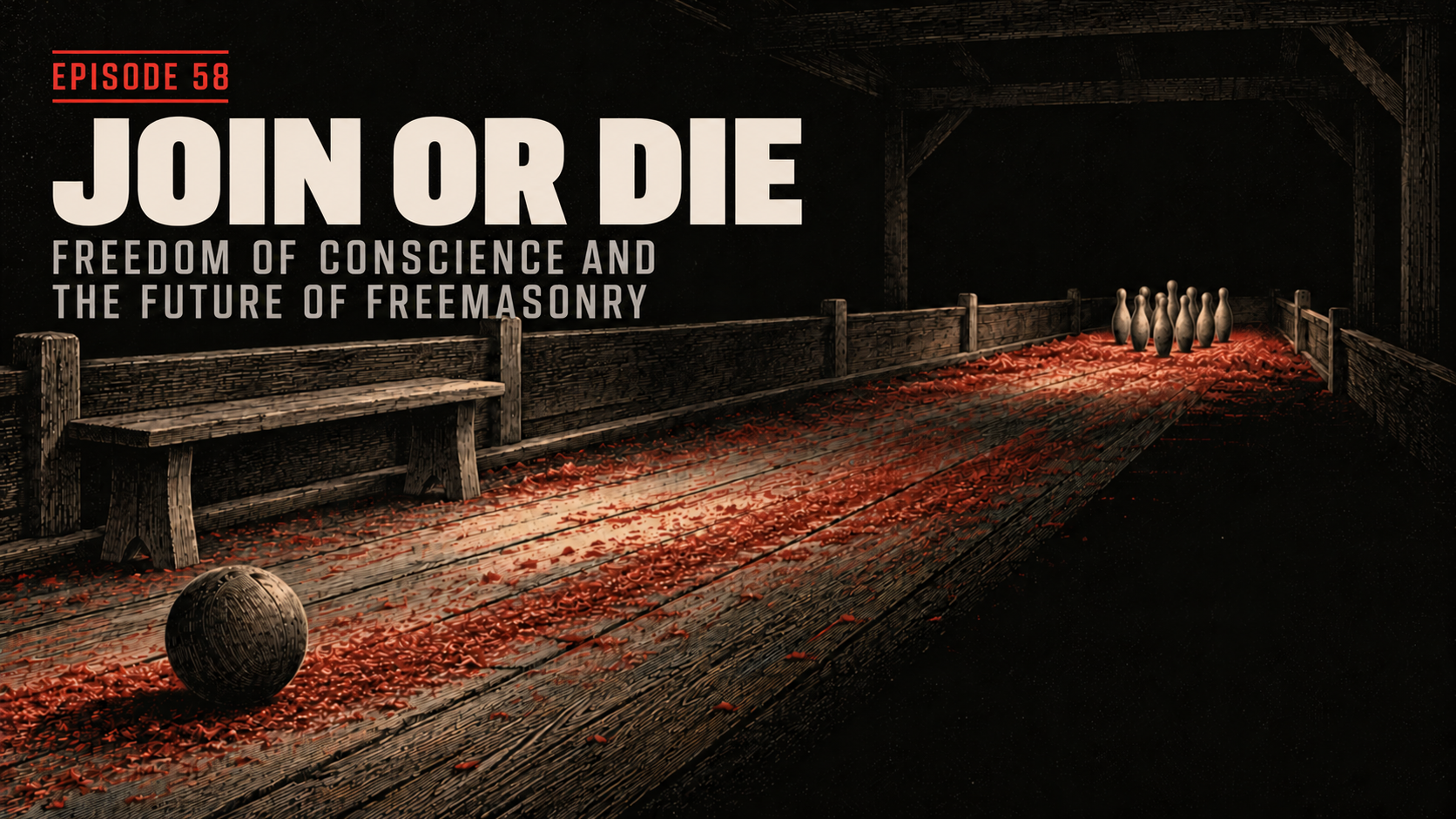
In Episode 58 of The Mystic Tye, Troy Spreeuw goes solo to ask why people join organizations and why they stop. Drawing on Robert Putnam's Bowling Alone and the documentary Join or Die, he makes the case that the future of Freemasonry depends on rediscovering what it means to belong, and on defending the freedom to disagree. What follows is Troy's script for the episode as written. Listen to the full episode at mystictye.com/episodes.
Key points
- Belonging, not just membership. Troy asks whether the future of Freemasonry depends less on convincing more men to join than on rediscovering what it means to belong.
- Putnam's social capital applies to the lodge. Drawing on Robert Putnam's Bowling Alone and the documentary Join or Die, Troy describes how voluntary associations build trust, cooperation, and networks of mutual assistance, and why Freemasonry is one of the surviving examples.
- Bridging beats bonding. Bonding capital strengthens ties among similar people. Bridging capital connects people across differences. Troy argues Freemasonry is at its best when it does the second.
- Freemasonry as a big tent. The esoteric Mason should not look down on the Brother who comes for fellowship, and the Brother with no interest in esotericism should not assume the student of Hermetic philosophy has less claim to his place.
- Your conscience belongs to you. A Brother's private beliefs are not public property, and the freedom to keep them private is as important as the freedom to discuss them. Brothers should be judged by their actions and integrity.
- Freedom of conscience is not freedom from disagreement. It requires learning to challenge ideas without attacking the dignity of the person, and to tell criticism from condemnation.
- Three Join or Die screenings. Saturday, November 14 in North Vancouver, Saturday, November 28 in New Westminster, and Saturday, December 5 in Vancouver. Free admission. Doors at 6:30 PM, film at 7:00 PM, with a discussion afterward.
- District 17 events. North Shore Lodge No. 93 on October 27, Capilano Lodge No. 164 on October 28 for the Freedom of Conscience presentation, and Triune Lodge No. 81 on November 10.
Join or Die: Freedom of Conscience and the Future of Freemasonry
In Episode 58 of The Mystic Tye, Troy Spreeuw goes solo to ask why people join organizations and why they stop. Drawing on Robert Putnam's Bowling Alone and the documentary Join or Die, he makes the case that the future of Freemasonry depends on rediscovering what it means to belong, and on defending the freedom to disagree. What follows is Troy's script for the episode as written. Listen to the full episode at mystictye.com/episodes.
Key Takeaways
Belonging, not just membership. Troy asks whether the future of Freemasonry depends less on convincing more men to join than on rediscovering what it means to belong.
Putnam's social capital applies to the lodge. Drawing on Robert Putnam's Bowling Alone and the documentary Join or Die, Troy describes how voluntary associations build trust, cooperation, and networks of mutual assistance, and why Freemasonry is one of the surviving examples.
Bridging beats bonding. Bonding capital strengthens ties among similar people. Bridging capital connects people across differences. Troy argues Freemasonry is at its best when it does the second.
Freemasonry as a big tent. The esoteric Mason should not look down on the Brother who comes for fellowship, and the Brother with no interest in esotericism should not assume the student of Hermetic philosophy has less claim to his place.
Your conscience belongs to you. A Brother's private beliefs are not public property, and the freedom to keep them private is as important as the freedom to discuss them. Brothers should be judged by their actions and integrity.
Freedom of conscience is not freedom from disagreement. It requires learning to challenge ideas without attacking the dignity of the person, and to tell criticism from condemnation.
Three Join or Die screenings. Saturday, November 14 in North Vancouver, Saturday, November 28 in New Westminster, and Saturday, December 5 in Vancouver. Free admission. Doors at 6:30 PM, film at 7:00 PM, with a discussion afterward.
District 17 events. North Shore Lodge No. 93 on October 27, Capilano Lodge No. 164 on October 28 for the Freedom of Conscience presentation, and Triune Lodge No. 81 on November 10.
The Problem With Joining Things
I've been thinking a great deal lately about why people join organizations. And perhaps more importantly, why they stop. We live in a time when we can communicate with practically anybody on the planet, instantly, at almost no cost. We can find communities of people who share our interests, our politics, our religions, our hobbies, and even our most peculiar obsessions.
And yet, by almost every measure, we seem to be having a harder time actually being together. We have more ways to communicate than ever before, and fewer reasons to leave the house. We've become extraordinarily good at finding people who agree with us, and remarkably bad at getting along with people who don't. Which brings me to Freemasonry.
We have this rather peculiar institution that has survived for centuries by doing something that modern society increasingly seems incapable of doing. We bring together men who don't necessarily agree about very much at all, put them in a room, give them a common purpose, and ask them to call one another Brother. And somehow, at least when we're doing it properly, it works.
Now, I don't want to romanticize this. Anyone who's spent more than about fifteen minutes on a Lodge committee knows that Freemasons are perfectly capable of disagreeing about absolutely anything. Including things that no reasonable person would ever imagine could be controversial. But perhaps that's part of the point. What if the future of Freemasonry depends not simply on convincing more men to join, but on rediscovering what it means to belong?
And what if the survival of our fraternity depends on defending something that is becoming increasingly uncomfortable in modern society? The freedom to disagree. Welcome to Episode 58 of The Mystic Tye, a podcast for Freemasons. I'm your host, Troy Spreeuw. Today we're going to talk about community, the documentary Join or Die, the philosophy of freedom of conscience, and a few things happening in British Columbia that I think are worth your attention.
And along the way, I want to make the case that these subjects are much more closely connected than they might first appear.
Why Join or Die Matters
Some of you will be familiar with the work of Robert Putnam, the political scientist whose book Bowling Alone became one of the most influential examinations of American civic life. Putnam observed that participation in the organizations that once held communities together had been declining. Service clubs, community associations, religious congregations, social organizations, and yes, fraternal societies.
People were increasingly doing things alone that previous generations had done together. The famous example was bowling. People were still bowling, but fewer were participating in organized bowling leagues. Now, on the surface, that might not sound like the end of civilization. Although I suppose if you happen to own a bowling alley, it might be a little concerning.
But Putnam's argument was much larger. These organizations create what sociologists call social capital. They establish relationships, trust, habits of cooperation, and networks of mutual assistance. They teach people how to participate in a community. And perhaps most importantly, they bring people into contact with others they might never otherwise meet.
The documentary Join or Die revisits Putnam's work and asks what happens to democratic society when these institutions disappear. I think this is an enormously important conversation for Freemasons to be having. Because we are one of those institutions. We are one of the surviving examples of a kind of voluntary association that was once an ordinary part of civic life.
And we shouldn't underestimate how extraordinary that is. Think about what happens in a Lodge. Men from different occupations, generations, economic circumstances, political convictions, and religious traditions come together and work toward a shared objective. They take on responsibilities. They learn to trust one another. They contribute to something that doesn't belong to any one of them.
And they develop relationships that may last a lifetime. That is social capital in action. But I think Freemasonry can offer something even more significant.
The Difference Between Finding Your Tribe and Building a Brotherhood
One of the great ironies of the internet is that it has made it easier than ever to find people exactly like ourselves. Whatever your interests, there is probably an online community devoted to them. And that's wonderful, up to a point. But there is a difference between finding people who already agree with you and learning how to live alongside people who don't.
Putnam distinguishes between two forms of social capital. Bonding social capital strengthens relationships among people who are already similar. Bridging social capital creates relationships across social differences. Both have value. But I would argue that Freemasonry is at its best when it does the second. When a man enters a Lodge, he shouldn't need to adopt the political opinions, religious interpretations, or philosophical convictions of the men already sitting there.
He should be able to enter as himself. And through the shared experience of initiation, ritual, service, and fellowship, develop meaningful relationships with men whose lives may be very different from his own. That is a remarkable thing. And it is something we should be extraordinarily careful not to lose. I sometimes wonder whether we have become so preoccupied with membership numbers that we've forgotten what membership is supposed to accomplish.
We count petitions. We count initiations. We count attendance. And those things matter. But the more important questions might be these: Are we creating genuine relationships? Are we helping men become more thoughtful, more responsible, and more compassionate? Are we offering something that they cannot get simply by scrolling through their phones?
Because if Freemasonry is nothing more than another social club, we're competing against a great many organizations that are frankly better at being social clubs. Some of them even have decent parking. But if Freemasonry offers a meaningful initiatic experience, a genuine philosophical education, and a brotherhood that can survive serious differences of opinion, then we have something rather special. And that brings me to freedom of conscience.
Freedom of Conscience and the Big Tent
On October 28, I'll be visiting Capilano Lodge No. 164 in my capacity as District Deputy Grand Master for District 17. I'll also be delivering a presentation entitled Freedom of Conscience. This is a subject I've been working on for some time, and one that I believe goes right to the heart of what Freemasonry claims to be. We frequently describe our fraternity as universal.
We speak about brotherly love, tolerance, and the ability of men from different backgrounds to meet upon the level. But how far does that tolerance actually extend? It's easy to tolerate somebody whose beliefs are only slightly different from our own. It's rather more difficult when those beliefs challenge our assumptions about religion, spirituality, morality, or the nature of reality itself.
And yet, isn't that precisely when tolerance begins to mean something? I have a particular interest in the contemplative and esoteric traditions of Freemasonry. Regular listeners to The Mystic Tye will know that. We've spent a great deal of time discussing symbolism, Kabbalah, Hermetic philosophy, Rosicrucianism, ritual, and the Western esoteric tradition.
And I've never made much of an effort to hide my own interests in these subjects. But I also recognize that esotericism is not for everyone. Not every Freemason wants to study the Kabbalah. Not every Brother wants to discuss the philosophical implications of initiation or spend his evenings reading obscure eighteenth-century manuscripts.
Some men come to Freemasonry primarily for fellowship. Others for charity, community service, or the opportunity to become better men through the practice of our moral teachings. And all of those motivations are legitimate. That's what I mean when I talk about Freemasonry as a big tent. The fraternity must be large enough to accommodate different approaches to the Craft.
The esoteric Mason should not look down upon the Brother who comes primarily for fellowship. And the Brother who has no interest in esotericism should not assume that the man studying Hermetic philosophy is somehow less entitled to his place in the Lodge. We don't need uniformity. We need mutual respect. And there is a significant difference between the two.
The Uncomfortable History of Conscience
Freedom of conscience is not simply the right to hold an opinion that happens to be popular. Historically, it has been most important when people held convictions that religious or political authorities considered dangerous. Consider the long history of conflict surrounding religious dissent, mystical practice, and heterodox spiritual traditions.
Some of the traditions that now interest historians of Western esotericism developed in environments where public disagreement with religious authority could carry very serious consequences. And not all esoteric movements were treated equally. Certain forms of Christian mysticism and initiatic practice could be tolerated within particular religious or social environments, while other traditions, especially those associated with ceremonial magic, grimoires, or Solomonic practices, might be condemned.
The history is complicated, and I don't want to pretend that all these traditions experienced the same kinds of persecution. But the larger philosophical question remains. Who gets to decide which forms of spiritual inquiry are acceptable? And on what authority? That question matters to Freemasons because our fraternity has historically brought together men whose religious convictions might otherwise have kept them apart.
We don't require agreement on every theological proposition. We establish a common moral framework within which men can pursue their own understanding. At least, that's the ideal. And I think we need to ask ourselves whether we always live up to it. I've spoken with Freemasons who have been advised to keep their private spiritual interests to themselves.
Don't talk about that in Lodge. Don't let people know what you're studying. Don't identify yourself too openly with a tradition that other people might misunderstand. And I understand why someone might give that advice. Sometimes discretion is simply prudent. But there is something deeply troubling about a fraternity that celebrates freedom of conscience while making its members afraid to exercise it.
Now, my own position is probably a little different. I've been rather public about my interests for a long time. It's probably too late for me to start pretending otherwise. But I would never suggest that another Brother has an obligation to reveal private beliefs or spiritual practices. Your conscience belongs to you. Your religious and philosophical convictions are not public property.
And the freedom to keep those matters private is just as important as the freedom to discuss them. What I object to is the idea that someone else's ignorance or prejudice should become the standard by which we judge a Brother's conduct within the Lodge. We should judge men by their actions. By their integrity. By their treatment of others. By whether they honour their obligations. Not by whether their private philosophy makes somebody else uncomfortable.
Freedom of Conscience Is Not Freedom From Disagreement
There is another side to this argument, and I think it's important. Freedom of conscience doesn't mean that every belief is equally persuasive. It doesn't mean we must abandon critical thinking. And it certainly doesn't mean we should be afraid to disagree. In fact, I think the opposite is true. A genuine commitment to freedom of conscience requires us to become better at disagreement.
We need to learn how to challenge ideas without attacking the dignity of the person expressing them. We need to distinguish between criticism and condemnation. And we need to accept that brotherhood does not require intellectual conformity. This is something I've tried to emphasize through The Mystic Tye. I want this podcast to be a place where contemplative and esoterically inclined Freemasons can encounter serious scholarship, interesting ideas, and like-minded Brethren.
But I don't want it to become an echo chamber. I've had the privilege of speaking with authors, historians, ritualists, philosophers, and practitioners who approach the Craft from very different directions. People like Lon Milo DuQuette, Ike Baker, Julian Rees, and many others. What makes those conversations worthwhile isn't simply that we agree with one another.
It's that we're willing to explore questions seriously. And I think that willingness is becoming increasingly valuable. The purpose of philosophical inquiry is not merely to collect opinions that reinforce what we already believe. It's to examine our assumptions. Sometimes to discover that we're wrong. And occasionally, if we're fortunate, to become a little wiser.
That is an important part of the initiatic journey. And I would argue that a Lodge should be one of the safest places in society for that kind of exploration. Not safe from challenging ideas. Safe enough to encounter them.
The Mystic Tye and Doing the Work
This is also where I think the future of The Mystic Tye fits into the picture. I've said before that I want this project to become a place where people interested in the contemplative and initiatic dimensions of Freemasonry can find education, ideas, and community. I want to feature people who are actually doing the work. The authors writing important books.
The researchers recovering forgotten parts of our history. The ritualists who take the Craft seriously. The teachers who are willing to share what they've learned. And the ordinary Brethren who are trying to make their Masonic experience more meaningful. But I don't want The Mystic Tye to become a substitute for Lodge. Quite the opposite.
I want people to take the ideas they encounter here back into their Lodges. Start conversations. Organize education nights. Improve their ritual work. Visit other Lodges. Build relationships. That's one reason the Esotericism in Freemasonry Conference has become so important to me. At our recent conference in Seattle, we brought together people who share an interest in serious Masonic education and initiatic practice.
We had presentations, discussions, and the kind of informal conversations that simply cannot be reproduced through a computer screen. And in our recent review of the conference with Brett Wolfe and Ken Lane, we talked about how transformative that kind of fellowship can be. You can read books alone. You can watch lectures alone. You can listen to podcasts alone.
But eventually, you have to encounter other people. You have to test your ideas. You have to participate. In other words, you have to join something. And preferably something that challenges you a little.
Three Join or Die Screenings
Which brings me to something practical. We're organizing three screenings of the documentary Join or Die in the Lower Mainland of British Columbia. These aren't intended simply as entertainment. We're hoping to bring together Freemasons, friends, neighbours, and members of the public to have a serious conversation about community.
About the decline of voluntary associations. About loneliness, civic engagement, and the importance of belonging. And, of course, about what organizations like Freemasonry might contribute. The first screening will take place on Saturday, November 14, at the Northshore Masonic Hall in Lynn Valley. The second will be Saturday, November 28, at the Freemasons Hall on Agnes Street in New Westminster.
And the third will be Saturday, December 5, at the Vancouver Masonic Centre. At all three events, the doors will open at 6:30 PM, and the film will begin at 7:00. We'll have a discussion afterward, and we're providing popcorn and water. So if the philosophical conversation doesn't appeal to you, at least there are snacks. But seriously, I want to encourage Brethren to invite people who aren't Freemasons.
Bring a friend. Bring a neighbour. Bring someone who has expressed curiosity about the Craft. And don't feel that you have to turn the evening into a recruiting pitch. The point is to have a conversation. Ask people what community means to them. Ask what kinds of organizations have made a difference in their lives. Ask whether they feel that something important has been lost as we've become increasingly isolated.
And then listen. Because if we want Freemasonry to remain relevant, we need to understand what people are actually looking for. I suspect that many are looking for precisely the things our fraternity has traditionally offered. Meaningful relationships. A sense of purpose. Opportunities to contribute. A connection to something larger than themselves.
But we shouldn't assume that simply because we possess these things in theory, we're necessarily delivering them in practice. That is work we have to do.
Upcoming District Events
Before I wrap up, I want to share a few upcoming events. As District Deputy Grand Master for District 17, one of the great pleasures of my term has been visiting Lodges and seeing the work being done by Brethren throughout the district. On Tuesday, October 27, I'll be making my official visit to North Shore Lodge No. 93. They're conferring a double Entered Apprentice Degree, and the Lodge tyles at 7:30 PM.
If you can attend, I encourage you to come out and support the candidates. On Wednesday, October 28, I'll be visiting Capilano Lodge No. 164, also at 7:30 PM. That's where I'll be presenting Freedom of Conscience, and I hope some of you will join us for that discussion. On Tuesday, November 10, I'll be making my official visit to Triune Lodge No. 81, with a 7:30 PM tyle.
And, of course, we have our three Join or Die screenings on November 14, November 28, and December 5. One other thing worth mentioning. Toward the end of November, we're planning another series of 5-Minute Ritualist classes on Zoom. Those of you who heard my recent conversation with Salman Arif will know how strongly I feel about the importance of ritual work.
Not simply memorizing the words, although that matters. But understanding them. Delivering them with conviction. And making the ritual a genuine experience for the candidate. If you're interested in receiving updates about those classes, visit mystictye.com and sign up for the email list.
The Brotherhood We Choose to Build
I want to finish with a thought. Freemasonry has survived for centuries. But longevity is not the same thing as inevitability. There is no guarantee that our fraternity will continue to thrive simply because it has existed for a long time. Institutions survive because people believe they are worth preserving. And because those people are willing to do the work necessary to preserve them.
Robert Putnam's work reminds us that communities do not sustain themselves automatically. They require participation. They require trust. They require people to show up. But I think Freemasonry adds another dimension to that argument. It asks us to build relationships that are not dependent on agreement. To recognize a Brother in a man whose beliefs, background, and experiences may be very different from our own.
And to find common ground without demanding that those differences disappear. That's not always easy. In fact, I suspect that if it were easy, we wouldn't need an initiatic tradition to teach us how to do it. But I believe it is worth the effort. Because a brotherhood that can only survive when everyone thinks alike isn't much of a brotherhood.
It's a club for people who agree with one another. And we already have plenty of those. What Freemasonry offers, at its best, is something more ambitious. A place where men can become better through their relationships with one another. A place where conscience is respected. Where disagreement does not have to become division. And where the work of building a better society begins with the work of becoming better men.
So come out to a Lodge. Bring a friend to Join or Die. Join us for the Freedom of Conscience presentation. Participate in the conversation. And remember that the future of Freemasonry isn't something that happens to us. It's something we build together. I'm Troy Spreeuw, and this has been Episode 58 of The Mystic Tye. Thank you for listening, and I look forward to seeing you in Lodge.
