The Lion, the Ox, the Eagle, and the Man: The Zodiac Hidden in the Royal Arch Banners
Walk into a Royal Arch chapter and look up at the banners. Four of them carry a strange menagerie: a lion, an ox, an eagle, and a man. Most Companions can tell you these come from the tribes of Israel, or from the vision of Ezekiel, and leave it there. But the Royal Arch banners hold an older secret than most of us are taught. Those four creatures are a star map. They are the four fixed signs of the zodiac, and the trail they leave runs back through Ezekiel's exile in Babylon to the winged guardians that stood at the gates of Assyrian palaces. This idea took center stage in a talk by Bro. Jaime Paul Lamb at the Esotericism in Freemasonry Conference in 2022, recently uncovered and released as Episode 43 of The Mystic Tye.1 Lamb is a professional astrologer and Masonic author, and his argument reframes a piece of furniture most brethren walk past without a second glance. Here is how the pieces fit.
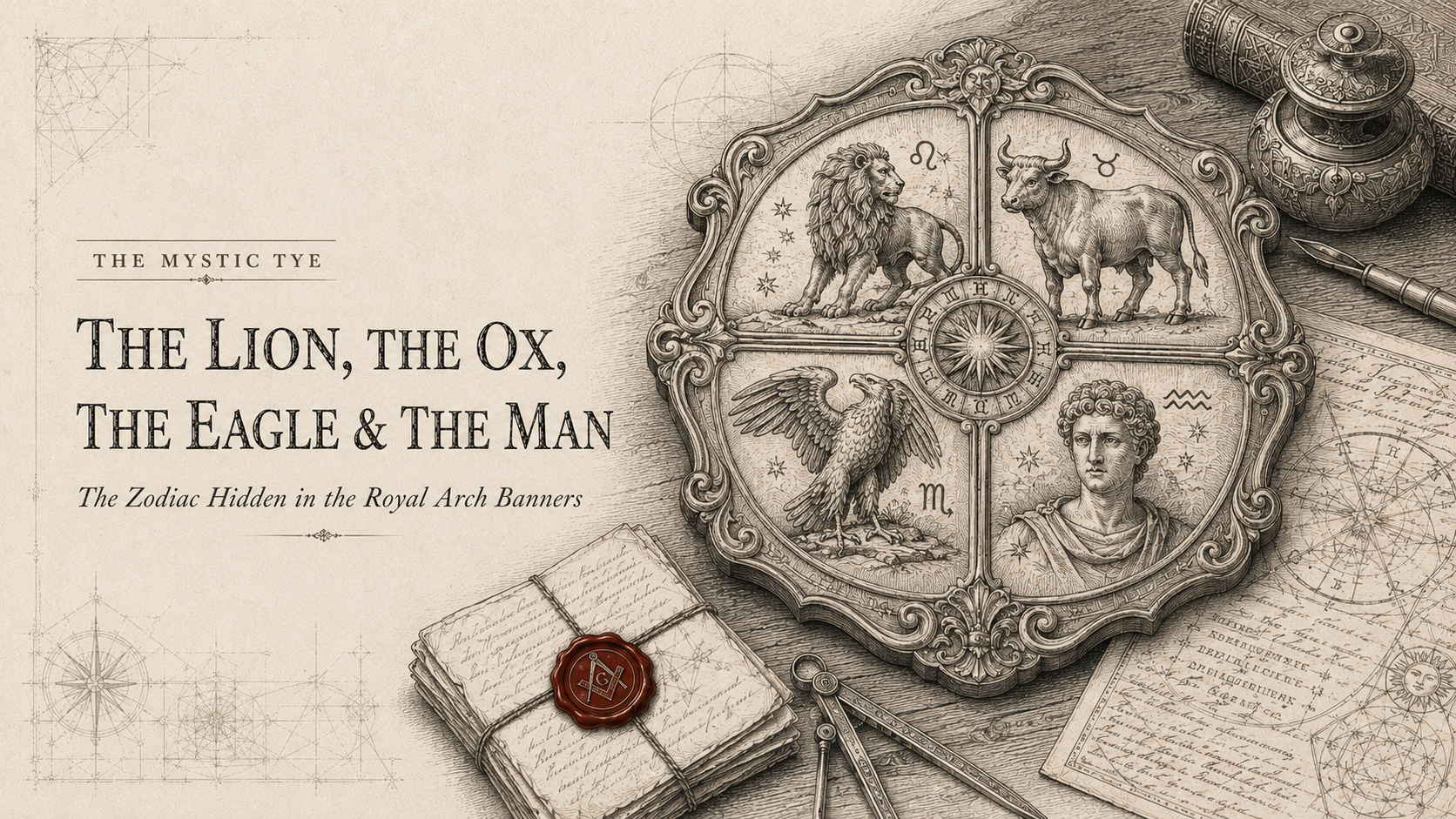
Walk into a Royal Arch chapter and look up at the banners. Four of them carry a strange menagerie: a lion, an ox, an eagle, and a man. Most Companions can tell you these come from the tribes of Israel, or from the vision of Ezekiel, and leave it there. But the Royal Arch banners hold an older secret than most of us are taught. Those four creatures are a star map. They are the four fixed signs of the zodiac, and the trail they leave runs back through Ezekiel's exile in Babylon to the winged guardians that stood at the gates of Assyrian palaces.
This idea took center stage in a talk by Bro. Jaime Paul Lamb at the Esotericism in Freemasonry Conference in 2022, recently uncovered and released as Episode 43 of The Mystic Tye.1 Lamb is a professional astrologer and Masonic author, and his argument reframes a piece of furniture most brethren walk past without a second glance. Here is how the pieces fit.
What the Royal Arch Banners Actually Depict
The four figures are traditionally read as the leading standards of the four principal tribes of Israel: Judah the lion, Ephraim the ox, Dan the eagle, and Reuben the man.2 In the Royal Arch, they anchor the twelve tribal banners around the chapter and echo the arrangement of the camp of Israel described in the Book of Numbers, where the tribes pitched their tents on four sides around the Tabernacle.3
That much is standard instruction. What often goes unsaid is why those four animals, and why in that grouping. The answer is not tribal at all. It is astronomical.
The Four Fixed Signs of the Zodiac
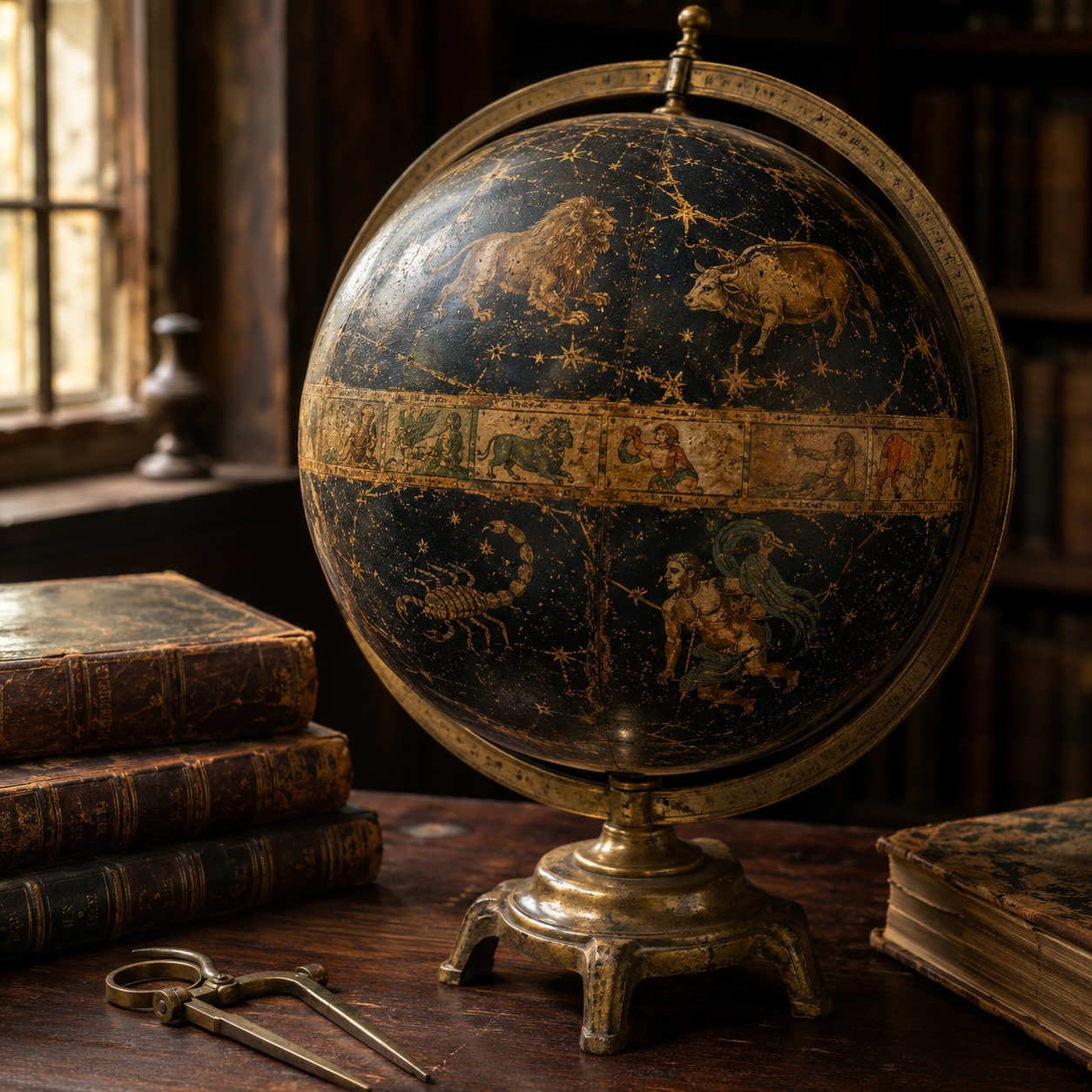
The zodiac divides into three groups of four: cardinal, fixed, and mutable signs. The four fixed signs sit at the stable center of each season, and they carry symbols any Companion will recognize once the connection is pointed out.
Leo is the lion. Taurus is the ox or bull. Aquarius is the man, the water-bearer. And Scorpio, in its older and higher form, is the eagle rather than the scorpion.4 Put those four together and you have the exact bestiary of the Royal Arch banners: lion, ox, man, eagle.
This is not a loose resemblance. As Lamb emphasized in his EFC presentation, the four fixed signs form a cross in the sky, four points spaced evenly around the zodiac wheel, marking the midpoints of the four seasons.5 Ancient sky-watchers treated them as the four corners of the heavens, the load-bearing pillars of the celestial year. The tetramorph, the four-in-one figure of lion, ox, eagle, and man, is a portrait of that cross.
From Babylon to Ezekiel's Vision
Here is where the history gets interesting, and where the Royal Arch degree quietly tells on itself. The degree is set against the backdrop of the return from Babylonian captivity. That setting is the key.
The prophet Ezekiel received his famous vision while in exile in Babylon. He describes four living creatures, each with four faces: the face of a man, a lion, an ox, and an eagle.6 Christian tradition later mapped these four faces onto the four evangelists, and you will still find them carved into cathedral stonework as the tetramorph.7 But Ezekiel was not inventing the imagery. He was living in Mesopotamia, surrounded by it.
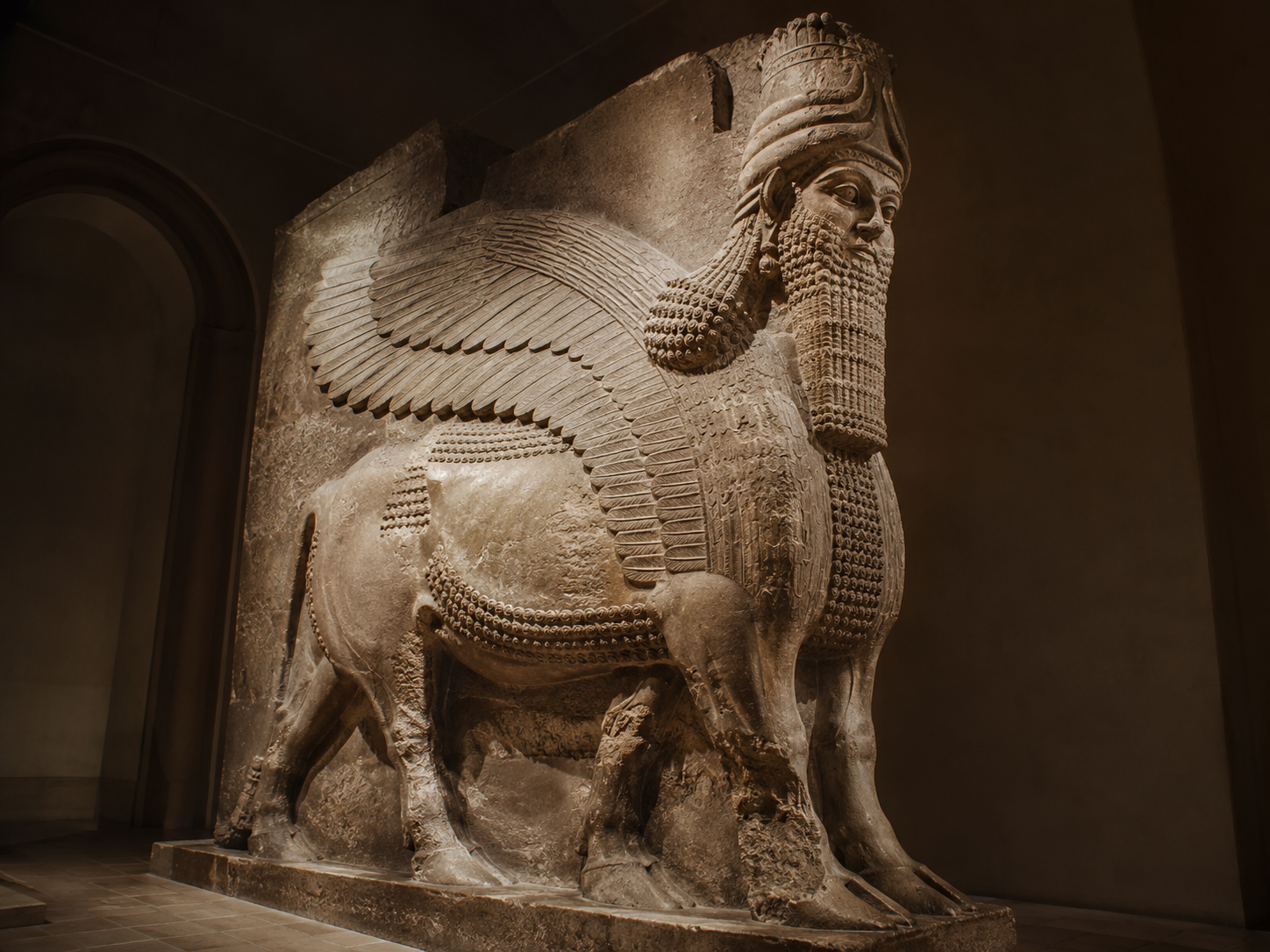
The Assyrians and Babylonians guarded their palace gates with the lamassu, colossal winged bulls and lions with human faces.8 These composite guardians fused the same elements: the strength of the bull, the courage of the lion, the wings of the eagle, the intellect of the man. Lamb draws the line directly. Ezekiel's vision took the celestial cross of the fixed signs, already old by his day, and rendered it in the visual language of the empire that held his people captive. The Royal Arch, set at exactly that moment of return from Babylon, carries the image home.
Why the Eagle and Not the Scorpion
One substitution deserves a note, because it is the piece that puzzles people. If the fixed signs are Leo, Taurus, Aquarius, and Scorpio, why does the fourth figure appear as an eagle?
In older astrological symbolism, Scorpio had two emblems. The lower form was the scorpion, tied to the sign's associations with death and the underworld. The higher form was the eagle, the same energy raised and redeemed, rising rather than stinging. Traditions that wanted the nobler reading, including the biblical and Masonic ones, chose the eagle. The scorpion and the eagle are two faces of a single sign, and the Royal Arch keeps the face that looks upward.
As Above, So Below in the Chapter Room
Why does this matter to a Companion beyond trivia? Because it changes what the chapter room is. If the four banners are the fixed cross of the zodiac, then the chapter is a model of the cosmos, and the Companions are seated inside a working diagram of the heavens. The Hermetic maxim as above, so below stops being an abstraction and becomes the literal architecture of the room.9
This is the thread Lamb pulls throughout his EFC talk. Astrology in the Western esoteric tradition was never just fortune-telling. It was the study of how the pattern of the sky imprints itself on everything below, and Freemasonry inherited that worldview along with the imagery that carries it. The Royal Arch banners are one of the clearest surviving examples, hiding in plain sight above the heads of brethren who pass them every convocation.
Key Takeaways
The lion, ox, eagle, and man of the Royal Arch banners correspond to the four fixed signs of the zodiac: Leo, Taurus, Scorpio (as the eagle), and Aquarius.
These four signs form a cross in the sky marking the midpoints of the four seasons, treated by ancient cultures as the four corners of the heavens.
The imagery descends from the Mesopotamian lamassu through Ezekiel's vision, received during the Babylonian captivity that frames the Royal Arch degree itself.
Scorpio appears as the eagle because the sign historically carried both a lower emblem (the scorpion) and a higher one (the eagle).
Read this way, the chapter room becomes a map of the cosmos, a physical expression of as above, so below.
Frequently Asked Questions
Are the Royal Arch banners about the tribes of Israel or the zodiac? Both, and that is the point. The banners are presented as the standards of the tribes, but the four principal figures trace back to the four fixed signs of the zodiac. The tribal reading and the astrological reading sit on top of one another, which is common in Masonic symbolism.
What are the four fixed signs of the zodiac? Leo (the lion), Taurus (the bull or ox), Scorpio (represented in its higher form as the eagle), and Aquarius (the man or water-bearer). They mark the stable middle of each of the four seasons.
Why is Scorpio shown as an eagle? Older astrological tradition gave Scorpio two symbols: the scorpion and the eagle. The eagle represented the redeemed, elevated expression of the sign. Biblical and Masonic sources favor the eagle.
Where can I learn more about astrology and Freemasonry? Bro. Jaime Paul Lamb's presentation on astrology in the Western esoteric tradition, recorded at EFC 2022 and released as Episode 43 of The Mystic Tye, is a strong starting point. Lamb has also written several books connecting Hermetic and astrological thought to the Craft.
Listen to the Full Talk
This is only one thread from a much larger presentation. In Episode 43 of The Mystic Tye, Bro. Jaime Paul Lamb traces astrology from ancient Mesopotamia through the Hellenistic world, the Renaissance, and into the symbolism of the lodge. If the Royal Arch banners have you looking at the chapter room differently, the full episode will do the same for the rest of the ritual. Listen now, and let us know what you hear.
Notes
Footnotes
Drawn from Bro. Jaime Paul Lamb's presentation "Astrology in the Western Esoteric Tradition," recorded at the Esotericism in Freemasonry Conference 2022 and released as Episode 43 of The Mystic Tye. See also Lamb's published works connecting Hermetic and astrological thought to the Craft. ↩
The pairing of specific animals with the tribes (Judah with the lion, Dan with the eagle, and so on) comes from Jewish tradition preserved in the Targums and Midrash rather than the plain text of Numbers. Tribe-to-figure and banner assignments also vary between Masonic jurisdictions and rituals, so check your own working before treating any single arrangement as fixed. ↩
Numbers 2. The four leading standards were arranged around the Tabernacle: Judah to the east, Reuben to the south, Ephraim to the west, and Dan to the north. ↩
Traditional astrological and esoteric symbolism gives Scorpio two emblems: the scorpion in its lower aspect and the eagle in its higher, redeemed aspect. ↩
In tropical astrology the four fixed signs are Taurus, Leo, Scorpio, and Aquarius. They fall at the midpoint of each season and were known in older sources as the fixed or "cherubic" cross. ↩
Ezekiel 1:10. Compare the related vision in Ezekiel 10 and the four living creatures of Revelation 4:6-7. ↩
The association of the four creatures with the Gospel writers originates with Irenaeus (Against Heresies, III.11.8) and was fixed in its familiar form by Jerome: the man for Matthew, the lion for Mark, the ox for Luke, and the eagle for John. ↩
Colossal winged guardian figures, the lamassu, stood at Assyrian palace gates such as those at Nimrud and Dur-Sharrukin (Khorsabad). Surviving examples are held by the British Museum, the Louvre, and the Metropolitan Museum of Art. ↩
The maxim derives from the Emerald Tablet (Tabula Smaragdina), a foundational text of the Hermetic tradition. ↩