The Omnipresent Magician: Ike Baker on Wilmshurst, the Book of Thoth, and EFC 2026
Three weeks before EFC 2026, Ike Baker joins Troy to preview both of his Seattle talks: the restored tracing board of Walter Leslie Wilmshurst, and the ancient Egyptian Book of Thoth as an initiation ritual. Plus a sold-out South of France retreat, a new book on the number theology inside the world's myths, and how a hidden page on Tool's website started it all.
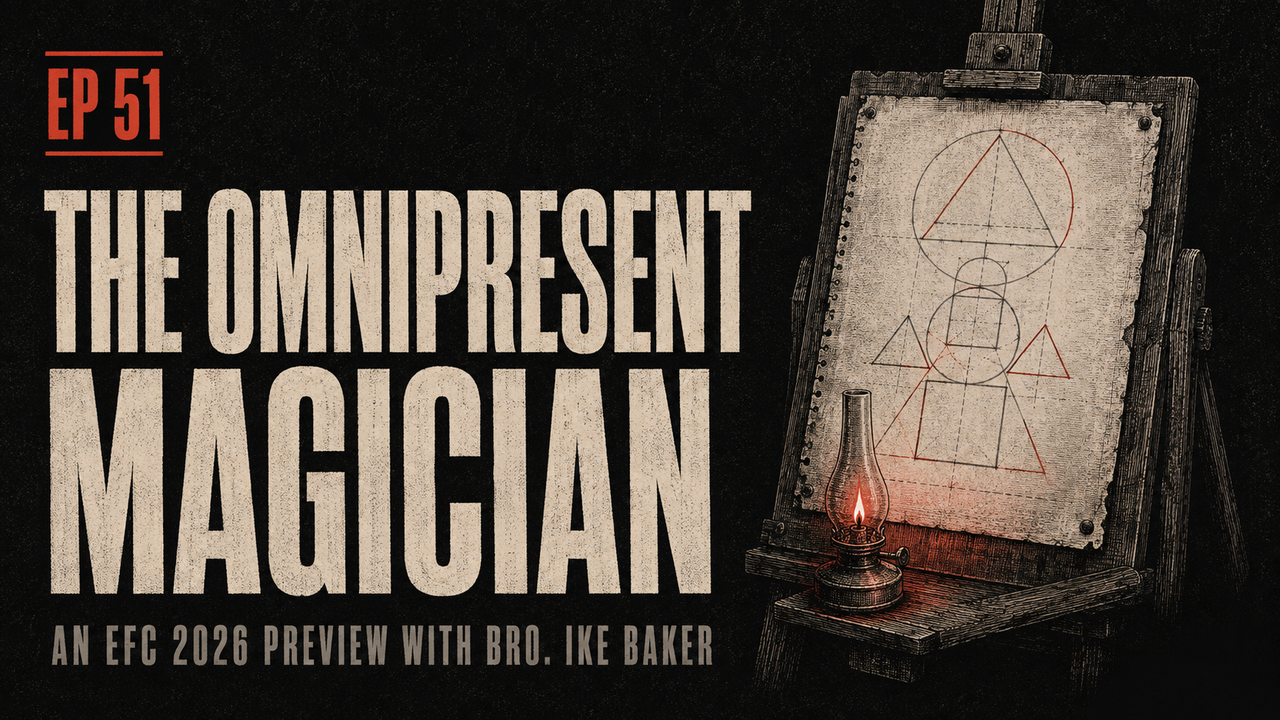
Three weeks before the Esotericism in Freemasonry Conference 2026, Bro. Ike Baker joined Troy Spreeuw for Episode 51 of The Mystic Tye. What follows is their conversation, edited only for readability. The words are Troy's and Ike's, as spoken.
Troy: Brothers like us don't have any pretense about needing a long preamble or a long catch-up. I feel like we turn the mics on and it's just you and me having a regular conversation that other people are listening into.
Ike: Absolutely. We have rapport, but also we both have the gift of gab. So dispense with all the pretense.
Troy: And I think the Masonic training takes, because I know there are certain things I won't step on over here, and if I do step on them, I know you wouldn't pick it up and beat me with it either. I'm not here to give offense, or to take offense, and vice versa. How can there be offense if nobody's given and nobody's taken?
Ike: Yeah, and I've got some pretty thick skin anyway.
Troy: Man, I have seen you all over the place. I think what we're gonna talk about tonight is the fact that I see you all over the place, and the variety of material you're covering as well. It's astounding how much you're putting yourself out there, just doing the work, and congratulations on all your success. I feel like you're a huge get now for EFC this year, because when you committed, that was a while ago. Now you're a married man, right?
Ike: Yep. I love being a husband.
Troy: Congratulations on your wedding. Some pictures of you and Jaime Paul Lamb on that trip surfaced, and I felt like I was a bit there vicariously, especially as our brother Lamb looks more and more like a hermit, with the beard.
Ike: Yeah. And that's the thing, now he's back. He's been a little bit more vocal on socials, which I think is really important. There was a gap left when he had to take a year off or thereabouts. He was traveling like crazy. You wanna talk about being everywhere, he was everywhere. I just feel lucky that a lot of the conferences I end up getting invited to, he's also either speaking or there doing something, so we get to see each other that way. I see him more than anybody else throughout the year. But truly, I wish I saw more brothers. It's just all over the place, all over the country, and all over the world at this point.
I like to tell people, almost facetiously, but not really, that if I didn't appear to be omnipresent, then all this hullabaloo about me being a magician would be hot air.
Troy: And you have to make it look easy too. You have to make the travel, which is not easy, folks, look effortless.
Ike: You do. And part of that is, and this is for all my Masonic brothers who know what I'm talking about, and those who don't but soon will, you've gotta make the logistics work. Back when I was just starting out on the Masonic scene, I would fly in sometimes, land at 12:00 somewhere, and be speaking at 6:00. You don't wanna do that anymore, because then it doesn't look effortless. You show up and you got bags under your eyes.
Wilmshurst and the Tracing Board
Troy: Let's talk a bit about that. You're gonna be traveling up here in a few weeks, on the Friday night, and then you're going to be speaking at EFC on the Saturday. You wanna talk a little bit about your itinerary and what you're coming here to do?
Ike: Sure. I've never been to Seattle. I was supposed to come for EFC a couple years ago, and we had Helene, which closed down everything, and I was still thankful that I was able to find a place in Charlotte that had Wi-Fi, and I gave a presentation.
Troy: You drove how far, in a hurricane, so that you could be with us? We said, "No, brother, you don't need to." You were like, "Oh, yeah, no, that's fine. I'll just drive two hours each way."
Ike: Look, my primary training in this kind of stuff where I'm presenting is in music, right? And music was an extension of show business. What's that saying? The show must go on.
I'll finally be up there. I'm gonna be speaking at Verity Lodge on Friday the 18th, presenting some material on Wilmshurst and his tracing board. I've been developing this material over the course of at least a year now, and it's super refined at this point. It's quite a fascinating document in terms of Masonic history, and there's still a lot that needs to be understood about it. But I was able to decipher almost the entirety of the chart myself.
Walter Leslie Wilmshurst, for anybody who's not familiar, was an esoteric Mason who wrote The Meaning of Masonry, Masonic Initiation, The Rite of Initiation, The Rite of Passing. He founded the Lodge of the Living Stones in Leeds in the UK. He was a Christian mystic, and just the quintessential esotericist of the early 20th century, fin de siècle era.
He left this tracing board that Brother Robert Lomas found when he was compiling his research at the Lodge of Living Stones. He found it in one of Wilmshurst's personal notebooks. Now, this is posted online, but the resolution is so poor that it's illegible. So I restored what could be restored. There's maybe one or two parts that are just entirely illegible, but I've restored the tracing board.
And what I realized: it's not pretty. A lot of Masonic tracing boards have beautiful images on them. Though obscure and mysterious, they're beautiful. This is not a beautiful tracing board. It's almost rudimentary in nature, because it's communicating in geometry. And I just so happened to specialize in Neo-Pythagoreanism and Hellenic and Hellenistic philosophy, so I was able to read this after working through The Meaning of Masonry with another brother out of Montana, Christopher Cavazos. He was the one who actually brought the tracing board to my attention, and we went through it together. So I'll be giving a presentation on that for Verity Lodge.
And then EFC, you got a great lineup this year, man. Dago Rodriguez, Joe Wäges, Lon Milo DuQuette. I'm privileged to be among that company this year, so thank you for having me.
Troy: Doug Russell is also gonna release his book at this year's event. We've been waiting and waiting, and we're very excited. It looks like we'll have copies. And it has been confirmed, Lon is coming in person. He doesn't travel a lot anymore.
You're talking about Wilmshurst. Since the last time we talked, I've put a podcast out every week for the last eight months now. So I've talked to a lot of Masonic luminaries, and one guy I talked to was Dr. David Harrison. He sent me these, I paid for them, but he happened to sign them. And I think these were both signed by Lomas as well.
Ike: Wilmshurst was incredible. I think Lomas' work is invaluable, because he's drawing attention to somebody who is perhaps well known in the niche sectors of esoteric Freemasonry, but really, Wilmshurst was a Mason's Mason as well.
What I love about Wilmshurst: he's writing in a time where you have many other Masonic commentators in the esoteric sector making all these bold claims, like Hewitt Brown, which is Stellar Theology and Masonic Astronomy. That's a phenomenal book, by the way. There was a tendency in many of the Masonic authors of that time period to attempt to tie Freemasonry back to an ancient tradition, pushing this idea that it was an unbroken chain, though underground. Whereas Wilmshurst was like, "Listen, it doesn't matter if this actually passed mouth-to-ear from ancient Egyptian initiates. What matters is that we somehow have many, if not all, of the touchstones of this ancient philosophy."
What an incredible scholar for his day and age. You go through The Meaning of Masonry, he's using Greek philosophical terms that were, in that day and age, obscure. We know them better now because academia is much more accessible with the internet. But back then, early 1900s, for him to understand Hellenic and Hellenistic philosophy to the degree that he did, while not doing that for a living, it was unbelievable. I wish I had a Wilmshurst in every lodge.
The Book of Thoth
Troy: So that's what you're presenting Friday night at Verity. Then on the Saturday you're presenting something totally different again. You wanna give the listeners a little taste?
Ike: Absolutely. This one has a little bit of a backstory as well. I just kinda stumble onto the things that interest me rather than actively seeking a lot of them out. I sit on an academic advisory board for something that's being launched this year called the Hermopolis Academy. It's myself, Dr. Aaron Cheak, Dr. Shannon Grimes, Dr. Charles Stang, Professor Wouter Hanegraaff, and we're working with Dr. Mervat Nasr's New Hermopolis Foundation. Siri Vevea is the CEO of the foundation itself.
What we've been doing is working through a text, a phenomenal text, to touch base with each other and stay engaged with the heart of this stuff rather than going into analytical territory that's not grounded in primary sources. The text is called Conversations in the House of Life, and it's actually a new translation of what is referred to as the ancient Egyptian Book of Thoth.
Now, you say "the Book of Thoth" to a lot of people outside of academia, and they're gonna have all sorts of things in their head. But this particular text is an actual primary source from ancient Egypt. The translation was put forth by Richard Jasnow and Karl-Theodor Zauzich. In 2005 they put out an academic version, and they decided around 2021 that they wanted to reissue it for the reading public. They didn't wanna just sequester this text in academic corridors, which is commendable. So it was retranslated and retitled Conversations in the House of Life.
We began reading that line by line, very slowly, and right out of the gate it just kept evolving. The correlations, the similarities to Freemasonic ritual are absolutely startling, in a way that I didn't even anticipate, not even remotely. In my own mind, I've let go of this idea that Freemasonry needs to be connected to anything ancient. But again, it's just unbelievable.
This text serves as an ancient Egyptian initiation ritual, specifically for the priests of Thoth, who were scribes. So this is like an entered apprentice degree. The structure of the ritual, the way the catechism develops, the symbols it uses, I think are enough to make any Mason perhaps a little bit more interested in this primary source material and its connection to Western ritual as a tradition. I don't wanna spoil too much for those that are going to be at the event, but I'm gonna be talking about this and its similarities, and showing a few other things that are apropos Masonic ritual and the Egyptian cosmology that accompanies this material.
Troy: I'm familiar with that book, but I haven't read it. I have a couple of different translations of the going forth by day and going forth by night, with a lot of the catechism that would be recognizable to other initiates. And it's one of those things: can these things develop and just keep happening on their own because this is the way people think? Or is this an unbroken tradition? And Wilmshurst, I would argue, it doesn't matter whether there's a historical connection or not. For those of us who are practitioners, we just wanna practice. Arguing over evidence this way or that doesn't matter so much. It's cool to know how they would go about it, and how similar modern man is to man from 4,500 years ago.
Ike: There's a lot that's similar, there's a lot that's different, but I think Wilmshurst would say that these are hallmarks of our humanity. And what's more, the product of the interaction between the soul and the personality: the part of us that is identified with, and tethered to, the body and its inclinations, which is by definition mortal, spatially specific, and having needs; whereas the soul, if we take the ancient worldview, is immortal, not spatially specific, and has no physical needs. These two antitheses are combined together in our sojourn here throughout the cosmos, and it is the product of both the dissonance and the consonance in that relationship that allows us to keep reinventing the same tradition over and over.
Troy: You're brushing up against something that I'm quite familiar with. There's a quote from The Book of the Law about the Khu and the Khabs. You're touching on the same material again. Everything old is new again.
Ike: And that's in the Corpus Hermeticum. There's nothing new under the sun.
Troy: You should be happy to hear that we've got record advance attendance, and it is possible we may sell out that venue, which is a big lodge, a big space. We've sold more tickets than several other years already.
Ike: Square work, brother. You're doing great stuff.
Troy: I think that's more about the word having spread, and the reach of the speakers themselves. We got a good lineup. We'd like to have Jaime and Danny and some other guys back in future years. I think we'll probably endeavor to get Arturo to come and talk in another year, and we'll see if we can get some people from across the briny too. A bunch of authors from Lewis Masonic have appeared on The Mystic Tye now.
The South of France
Troy: I know you've been working on other things. Do you wanna talk about Ike Baker travel agent, or Ike Baker author?
Ike: I'll start with the France trip. I was approached by Tana Elise over at Magical Retreats. She runs some phenomenal stuff. She's done some stuff with Lon at Joshua Tree. She works with Lee Barlow, who is a Pythagorean doing work in Hermeticism, from the UK. She's done a lot of retreats at this point, but she asked me to lead a retreat in the south of France.
I was hesitant at first, but after a little thought, I bit into it. A lot of people know me as a Freemason. A lot of people know me as a Golden Dawn chief. Not a lot of people are aware of the extensive background in French esoteric orders that I have: Martinism, the Élus Coëns, all sorts of French Rosicrucian lineages, the OKRC, so on and so forth. This was a big part of my development and a massive part of my understanding of Western esotericism. However, there are a lot of incredible commentators out there doing that work. Matt Ravenat is one of them. Matthew Fletcher is another. So I thought to myself, where do I fit in? I kinda don't. In matters where other people can speak more authoritatively, I should just keep my mouth shut, which for me is a hard thing to do.
But I jumped at this because I finally will get to engage in a private setting with these traditions and share them with others who are interested. We're gonna be doing a full week in the South of France. We're gonna be going to Cathar bastions, their last holdouts, and different consecrated topographical features, these caves that were first consecrated and used as places of worship by Visigoths, and then over time consecrated by Cathars. There are Templar strongholds down there. The whole works.
The main thing for me is that I'm going to do my best to highlight the French tradition specifically, in and around the Occitanie region. This includes Martinism. This includes the Élus Coëns. Arthur Edward Waite, writing about Martinez de Pasqually, identifies that his first known locations are in or near the South of France, when he begins opening up these chapters of Coëns, priests. I'm gonna be connecting stuff to the work of Eliphas Lévi, the French Occult Revival. We have the second earliest declaration of Rosicrucian presence in Europe in France, no later than 1625, about ten years after the first manifesto is published.
So there's a lot there. There's Templarism, there's Catharism, there's that brand of, I hesitate to call it Gnosticism, but it certainly shares features with Gnostic cosmology and soteriology. And then you see a similar interpretation of Judeo-Christian scripture coming out of somebody like Martinez de Pasqually and his treatise on the reintegration of beings. There's this really interesting thing happening in the South of France that is quintessentially heretical, and from it several different expressions of esoteric Christianity burgeoned forth. Hence the Albigensian crusade, the massacre of the peoples generically and somewhat erroneously classified as the Cathars. There's a lot of false history, that kind of Dan Brown history of Southern France, that Tana is also gonna be helping me dispel.
One of my favorite features of what we're gonna be discussing is Marian devotion, because the cult of the Black Madonna is massive down there. We're gonna be approaching the divine feminine through things like the sacred geometry of cathedrals. It's gonna be a really wild exploration and a lot of practical stuff. We sold out in just under two weeks, and we're considering doing an encore at some point, either in France or in Joshua Tree. I've never been to France before, so this will be somewhat of an initiation for myself as well.
Troy: I hope you have an amazing time. You're going to the center of early Rosicrucianism, or one of them.
Ike: I would absolutely say so. There's even precursors to Rosicrucianism, at least in the style practiced by the French, because German Rosicrucianism and French Rosicrucianism are different things. English Rosicrucianism is this mishmash of both of them, because of how interested in the work of Lévi they were. A lot of modern people aren't necessarily aware that Eliphas Lévi, Martinez de Pasqually, they all claimed in their private writings to be Rosicrucians. Lévi identifies himself in his letters to his students as a Rosicrucian. Same with Pasqually, in certain private ritual instructions. He was initiated as a Rosicrucian. That's where this teaching of the Élus Coëns comes from. It's very Solomonic in terms of its ritual style. And that French iteration, which is quintessentially Catholic, applied to this Solomonic style along with this Rosicrucian and Neo-Hermetic philosophy, it's just such an interesting brew. It's got all the meaty stuff that I really enjoy.
Rosicrucians and Radical Freedom
Troy: We spent a lot of time talking about freedom of conscience the last time you were here. Now, the actual Rosicrucians that were laying down the traditions which we practice would have a lot to say about that, because many of them suffered physical calamity for their beliefs. They were violently, physically suppressed more than once. You wanna talk a little bit about how wonderful it is to be free and be able to march around Southern France and discuss such things openly? The Inquisition won't be showing up and placing you under arrest.
Ike: Yeah, put the screws to me. And that's another interesting thing: the Inquisition was literally started to deal with the Albigensian heresy. There's a lot there that serves as a precursor to this esotericism that emerges in that country, in that time and place.
The thing about Rosicrucianism for me, and here I diverge from a lot of the common zeitgeist in esoteric Masonry, I don't think there were any true original Rosicrucians. I don't think that matters. I think the scholars, or whomever penned those first manifestos, intended to perhaps start an intellectual movement. And regardless of whether or not they were a band of initiated secret agents set about to change the world, it doesn't really matter, because it kinda happened. The intellectual zeitgeist of the time became obsessed with Rosicrucianism.
And yes, it had to be hidden, particularly in places which were still Catholic. It's a product of those first leanings toward intellectual freedom, where there's a literate intellectual society that can communicate at much more of a global level because of the printing press and the university systems. A lot of people don't realize universities weren't always a thing. So there are these networks of scholars able to keep this stuff very hush-hush. And remember, one of the hardest parts about identifying any quote-unquote true Rosicrucian source is that they explicitly state, several times, that they intend to remain anonymous as individuals. So if you were to go out and tell somebody, "I am a Rosicrucian," there's arguably no better proof that you are, in fact, not a Rosicrucian.
What we end up with is a beautiful intellectual culture that has always been at the forefront of that radical freedom. And I do believe that the earliest Freemasonic movement and the Rosicrucian movement have danced with each other. I find them to be extremely related, not only in history, but in ethos and in practice. It's almost as if Freemasonry is an outer court to something like Rosicrucianism. I'm not making any claims. But there you go.
Troy: We'll have copies of this on the table at EFC, and Josef Wäges is gonna be talking about The Secret Freemasonry of a Priest in the Temple of Nature, Johann Samuel Mund's Rosicrucian Freemasonic system. European Freemasonry was always, how can I say this, more esoteric than what went on in England. If you haven't listened to my interview with him about this book, you should check it out. He's gonna cover those early forays of the Rosicrucian tradition into Freemasonry, because this is older than the Golden Rosy Cross.
Ike: It's gonna be surreal for me to be sitting in front of him, listening to him give the presentation.
Tool, Rennes-le-Château, and How It All Started
Troy: I got off a cruise ship in 1997, '98. I was in London, at the museum there, and I had just finished The Templar Revelation. They talk a lot about Da Vinci in there, and I remember being at the museum with a crowd of people around me, going on and on about this book. It was one of the reasons I became a Freemason. I read The Temple and the Lodge, and Holy Blood, Holy Grail, and I was full-blown into conspiracy stuff when I read The Templar Revelation.
Ike: There's a lot in Holy Blood, Holy Grail that's not necessarily 100 percent historically accurate, but I'll tell you this, man. Another reason why I jumped at this chance to go to France is because I actually got started down the esoteric path specifically because of, I call it, being facetious, Dan Brown occultism. It was really Holy Blood, Holy Grail.
I remember being 16, 17 years old, in first period computer lab. You're supposed to be learning how to type. I was barely awake in school. But I would go on Tool, the band Tool. I'd go on their website every morning, because they had this guy, Blair McKenzie Blake, who used to write a blog for them. He wrote their newsletter. I think he still might, for Tool Army. He did a lot of traveling, and he traveled with Danny Carey a lot.
There was this little thing on the Tool webpage, totally accidental, in the header or the margins, and if you clicked on it, it would take you to this secret part of their website. And the whole thing was this mystery of Bérenger Saunière and Rennes-le-Château. Which we're gonna be going to.
I read this whole thing one morning, and I can swear on this podcast, right?
Troy: Oh yes. Swear the fuck away.
Ike: Okay, will do. I read this whole thing one morning, and I was like, "This is the coolest fucking band on Earth." They have a separate hidden part of their webpage that's just all about these mysteries of Asmodeus, this strange, mysterious priest, all sorts of inversions of Catholic Christianity, moving toward this feminine veneration. I thought it was the coolest thing, and it really got me interested in studying things like Freemasonry. And so now I feel like I'm coming full circle. I'm going to be at Rennes-le-Château with a group next year.
Troy: I just reached into my good bookshelf. You ever read this? This is still in print. This is like Catcher in the Rye for conspiracy theorists. I didn't find it until after I had read all that other stuff. This is the conspiracy theory book that started the conspiracy theory craze in the '60s, I think. This is like the I Ching of conspiracy theories. For listeners that don't know, if you wanna think and talk like people like me and Ike, this is the kind of baseline reading you need to attempt. And I like Robert Anton Wilson, don't get me wrong, but it took me forever to get through all of the Illuminatus. This, because it purports to be mostly factual, if you wanna run in these circles, you gotta do the baseline reading.
Ike: Did you get involved in Freemasonry to see if the Freemasons actually controlled the world? Or out of a sincere sort of desire?
Troy: My initial curiosity, and I joined another order before I joined Freemasonry, the initial curiosity is because of my conspiracy reading, and The Templar Revelation, and that trip we took to Greece and then England. But I knew that it was largely erroneous. I was put on this trajectory, I think we had this conversation before, because of heavy metal music, and video games, and Dungeons & Dragons, largely. I was a reactionary Christian as a teenager, and I got reformed up real quick when I started getting exposed to this stuff.
When I found that so many of the thinkers I enjoyed reading had good things to say about Freemasonry, or were detractors of Freemasonry but would point out that the ideas were good, it was just the actual practitioners that were the problem, how often do you hear shit like that about just about everything? That's why I joined. People were arguing about it. That's how I became a Thelemite too, listening to John Crow and Keith Schirholz on Thelema Coast to Coast arguing about Thelema and why people don't take it seriously. That's why I picked up Crowley at the local bookstore. That's why I got The Book of Lies and started taking that stuff seriously.
And it's harder and harder to take that stuff seriously and talk about it publicly, by the way. There was a guy in Oklahoma recently that's been brought up on Masonic charges for being a Thelemite.
Ike: Really? You can do that?
Troy: Freedom of conscience should be sacrosanct, and when you ask the question, "Do you believe in a supreme being?" and somebody answers yes, that should be enough. It's one thing for the Concordant Bodies to keep people out, that's fine. But it's not for a Craft Lodge. If a guy's good, keeps to his obligations, and he's answered yes to the one question we ask, that's enough. At least to me. I was getting ready to scream about it, but I will not be screaming about it yet.
Esoteric Mythology
Troy: You got another book coming too, don't you? You're like Jaime Paul Lamb, book after book.
Ike: Yeah, and while he and I are slaving away at our books, we're also sending each other chapters. "How is this? Does this suck? Is this a piece of shit?"
Troy: That's what peer review looks like, ladies and gentlemen.
Ike: Exactly. Is this garbage? Because if it is, I'm just better off drowning myself at this point.
It's called Esoteric Mythology, and I just got a notification today from my editor at Inner Traditions that we're going to press in late September, and we're still on track for a November release.
What I wanted to do is speak to the mythological component, because this too is something that runs deep in my blood. I'm ethnically Greek. My father's from Greece. My mother's family is from Sicily. I grew up being told Greek mythology in Greece. I remember my father telling me the story of Theseus and the Minotaur, and how King Aegeus, his father, cast himself into the ocean when he saw the ship returning with black sails, though Theseus had been successful, and hence the Aegean Sea got its name. He told me that while we were both staring off into the Aegean, on a cliff at the Temple of Poseidon at Cape Sounion. This stuff is baked into my bones.
Learning more about other types of mythology as I got interested in Daoism, ancient Egyptian, ancient Mesopotamian, and Celtic material, I realized there were a lot of commonalities that are not arbitrary. These commonalities primarily persist in the cosmological and cosmogonical mythologies: the structure of the cosmos, the way it's created and maintained, ways of talking about it prior to our modern scientific empirical vernacular. And behind all of it is this really strange, amazing, beautiful theology of arithmetic. We're all talking about numbers, anthropomorphizing this number theology into forms that are less abstract, that we can relate to.
One of the main things I tried to do in this book is not what your non-PhD author does, taking a bunch of myths and saying, "Here's what I think they are, and this is my truth," unverifiable personal gnosis. Rather than do that, I went back into the mythological tradition as it's commented on in the ancient philosophical traditions: Daoism, Hellenism, Egyptian hieratic practices. There are vast canons of material interpreting mythology esoterically. So I take the myths, and the number theology behind them is revealed based on what the ancient authorities had to say about them, philosophically, metaphysically.
It was an unbelievable time writing this book. One of the highlights of the last five years of my life. I'm about to launch out on a book tour for it: East Coast, West Coast, Northwest, Northeast. I'm gonna be doing a talk for the Embassy of the Free Mind at the Ritman Library in Amsterdam in November, the 19th, and then on the 20th, Wouter Hanegraaff and I are gonna do a discourse for the public. Then Parma, Italy for two days, a workshop, and then London for a series of dates. I hope anybody that's listening will feel free to reach out. If you're on that side of the pond, I'd love to link up with any brothers and co-Masons interested in meeting up while I'm in Europe.
Troy: What are your West Coast dates gonna be?
Ike: Technically my book tour starts when I come into Seattle. But I'm really dialing into the meat and potatoes of the book in October. Four consecutive dates: I'll be speaking for a Swedenborgian group on the 22nd. The 23rd, the Adocentyn Research Library in Berkeley. The 24th, in LA at an esoteric salon hosted by Brother Michael Samu. And the 25th is the main event. I go every year to the Philosophical Research Society. My first job doing any of this stuff was writing for PRS's journal. I make my pilgrimage. I love Manly Palmer Hall, and I'll be doing a big talk on the book there.
Troy: If you get a chance to get up to Vancouver, I'm sure Banyen Books would host you, or maybe we could do something with the Masonic Center. We should talk. It's only a couple hours' flight. It's only a 28-hour drive from LA to Vancouver.
The Podcast Life
Troy: With all of that, where do you find time to make podcast episodes? Because I see you've been putting episodes out again.
Ike: If I stop, it's only for a month. A lot of these people are my friends. It used to be very difficult for me, believe it or not, to interview people, because if I don't know somebody, I have a tremendous amount of nervous energy and anxiety, and after about an hour I feel like I'm gonna throw up, so we have to end the episode. But people like Jaime I knew way before I had the podcast. John Michael Greer I knew before I had the podcast. A lot of the guests I've had on have become friends, so it's just, "Hey, do you wanna meet up for an hour to have a talk?" I think by now people know that I'm gonna conversate with them rather than sit there and interrogate. I hate interrogations.
At this point I'm pretty much full time: teaching courses, teaching private one-on-one students, speaking, writing books. When you're full time in this kinda shit, one of the big benefits is that you can make your own schedule. Although there are some days, I know I'm gonna be traveling extensively in November, so inevitably in October I'll have two days where I'm doing back-to-back interviews for six hours. And that will suck. But sometimes some of the coolest conversations come when I'm basically loopy, my agenda goes out the window, and I'm just like, "Hey, what kind of soup do you like?"
Troy: It's just a conversation. This is like having a visit with you that the listener gets to listen in on. And now I've graduated to video, so people will get to see us.
Ike: I'm loving your clips, man. I'm loving your reels. Classy.
Troy: Thanks. It's practical marketing. Apparently people don't have the attention span for a 90-minute podcast. Who knew? Martin Faulks, when I had him on earlier in the year, I asked three questions and he talked for two and a half hours.
Ike: I love talking with Martin for that reason. He'll just go, and it's hard to hold on to everything he says, because he's brilliant. One of the things I do now is prep my guests: please feel free to be as long-winded as you like. Don't feel like you're talking too much. You're the guest.
Troy: I'm really trying to rein in my enthusiasm, because I interrupt everybody all the time. I do that in real life, but that's tough luck. I interviewed Bridie Blaze and Jonti Marks about their Masonic wisdom deck that Lewis just put out, and it was a three-way, and we were all interrupting each other for the entire 90 minutes. It was like we were having dinner.
Ike: There's a sincerity to that, man, that I really enjoy. I find all the artifice, especially with the volume of podcasters, the format has become, frankly, fucking awful. To be honest with you, I don't even listen to occult podcasts anymore. I'm sick of them. I'm sick of the narrative, the curating of all of it. I listen to comedy podcasts. It's basically two or three people acting ridiculous for two hours. That I can listen to.
Troy: That sounds like what we're doing over here. Take the work seriously, but don't take yourself seriously. I really want people to let their guard down and have fun.
Lon
Troy: I don't know how much time you've got to spend with Lon, but I really hope you can appreciate the time you'll get with him at this event, because he is a true Masonic treasure, and he just isn't out and about anymore. He will be going to Joshua Tree for your friends at Magical Retreats in the spring. He was just teasing it today. I think he's gonna do another Lamed Ben Clifford book. I think there might be another Chicken Qabalah.
Ike: Lon is fantastic, man. I've never met him in person. Obviously I've had conversation with him for the podcast, but he's a living legend, dude. He constantly makes me laugh, but the interesting thing is that he'll stop and say something so incredibly brilliant. This whole number theology thing I was talking about, Lon understood that probably 40 years ago. He's one of the sharpest people when it comes to this Pythagorean way of looking at things, and he explains it very well. That, interspersed with this quick-witted humor. It's perfect for me.
Troy: You ever been present when he plays music? He had a record contract in the '70s. While he was a student of Crowley and studying magic, he was Charley D. and Milo, and they put out a couple of records. And a few years ago he put out a few more. For my 30th birthday, he was the headline entertainment at the Railway Club here in Vancouver. One of my favorites he ever penned is I Love to Get Drunk in the Car, this very irreverent treatment of a guy who likes to drink in the car as opposed to at a bar or at home. Talking to him about it over the years, he always says it doesn't matter what we write about our academic pursuits, but a song that catches could live forever.
When he's here, he may entertain us in the bar in Seattle we go to, that used to be a sex club. There will be pictures. You are warned.
EFC Weekend and What Comes After
Troy: That'll be the night of the 19th, probably also the night of the 18th. Many years we did stuff on the Sunday too, but it really interfered with people socializing on the Saturday night when we insisted on getting together Sunday for more serious magic work. It's a one-day event, and a one-night event only if we end up at the pub. I'm so stoked to have the group of you here. Do you know Josef Wäges? He is an absolute stellar human being.
Ike: Obviously I know his work. He's another legend in Masonic scholarship. Joe and I have interacted on social media, and he has been like the elder brother of what we do. He's extremely encouraging, very generous with his wisdom. I can't wait to meet everybody in person. I know Dago, obviously. Dago's a fantastic guy and a great brother, and the work that he does at the Southern California Research Lodge is unbelievable. Between Fraternal Review and the Illumination Lecture Series, that's gonna go down in Masonic history. It kinda already has. Props to you, man, for bringing everybody together.
Troy: These things come together organically. We curate it, for sure. In talking to Doug Russell, because Dago and Angel and those guys kinda took over from what Doug was doing at the Fraternal Review, they've done such a good job. I think we will endeavor to get Angel Millar in a future year, and certainly on this podcast. I've already invited him.
Ten years ago, maybe further back, I heard him on Occult of Personality with Greg Kaminsky, and several things he said infuriated me. I was throwing shit at my radio. And I use that as an example: if you're saying stuff that makes people angry like that, you're the right person for over here. I think Angel is very keen on guys being in good shape, especially occultists. And at the time... I've lost a huge amount of weight, I've taken my health much more seriously recently. Whatever shitty thing he was saying that made me so mad, it might've been that that changed me. I might've been like, "Fuck, I better do something about this."
Ike: There you go. That's the right way to take stuff like that. Have the reaction, sure, absolutely, it's very human. But then it stays with you, and it creeps in, and you're like, "You know what? I could probably just use this as fuel for something productive."
Angel is fantastic. He was one of the first guests to come on my podcast, which is incredible, because he's a more well-known name and I was virtually unknown at the time. He's the editor-in-chief now, taking over for Doug Russell at Fraternal Review. I've guest-edited editions for them. I write fairly often for it. Angel is always the guy who's, he's Caesar, right? Thumbs up or thumbs down. I learned a lot from his notes on how to write and how to be more clear, and that is an invaluable thing to learn as an author. And he's just good people. We're gonna go to lunch when I'm up in New York in a couple of weeks.
Troy: Just maintain your connections. There have been some good questions I've had to edit out recently. Alex Rofaila asked me, "What are you doing here?" And I tip my hat and I'm like, "It is my will to square the circle with Crowley and Freemasonry." I want Thelemites to be left alone. You don't have to approve of The Book of the Law, that's a reach. But I wanna be the exemplar that people would hold up, rather than all the people that are motivated to keep us out. I don't think there's any reason to keep us out. We're not the threat. There's clearly bigger threats.
Ike: Alex is great too, man. I find him to be an exemplary character. He was one of the presiding officers at my SRIA initiation a couple years ago. He hosts the Metropolitan College study group. He asks really good questions. He's just very friendly. And I'm gonna be submitting an article for the second volume of The Rosicrucian.
Troy: They've got a whole stack of them here at Grand Lodge. They're turning up everywhere. It's a very popular item. And I didn't make the connection originally, but after I got talking to Alex, I made this connection that we have Moore's Bumper Book to thank for the production values, the full color bleed, the graphic novel feel of that. I just think we need more stuff like that. Not pop occultism, but stuff that doesn't just have cool material, but looks and feels cool. Like a cool piece of memorabilia that you wanna hold onto.
Ike: It really is. When I purchased it, it was sandwiched in between these beautiful leather-bound volumes, and I just immediately gravitated towards this thing. It's that part of me that grew up freaking out any time I saw a new comic book or graphic novel. I hadn't really understood that until you said it just now.
Troy: I think that's The Dark Knight Rises of our occult generation. The Esoteric Book Conference in Seattle ran for eight, ten, twelve years, and during that time there was a big resurgence in occult periodicals that kind of drifted away again. I've got a whole stack of them here. Some got one or two or three editions and have been forgotten. Others are still going. My thanks to guys like Alex that are willing to put in the time and effort to publish a periodical like that, because it is thankless work. I joked with Dago about it too: you do all this work, put it out there, and then you might as well have set it on fire, because next week you gotta start all over again for next month.
Courses and the Liberal Arts
Ike: As far as what I've got going on, I've got a bunch of dates. I'm teaching some public courses right now. One of them is The Magic of Dion Fortune; we're about halfway through that. I've got two courses starting in October, both public, anybody is free to inquire and register. I keep them extremely affordable. If you look at other people's courses, you're looking at upwards of $1,000. I charge nowhere near that for arguably much more material, because I can't shut up, so each module is three hours long.
Starting October 5th, in four modules: Ad Lucem: The Art and Practice of Rosicrucian Ceremonial Evocation. And on opposite weeks, another one called Astral Travel and Vision Magic, which is self-explanatory. These are all live, but also all recorded for anybody that can't attend; you can download them and keep them.
Other than that, I've got private students, and I just started on a new trajectory that I think might be interesting to Masons: I am teaching a one-on-one course of study of the seven classical liberal arts. Grammar, logic, rhetoric, arithmetic, geometry, music, and astronomy, as they are given to us in certain Masonic degrees. This, to me, is probably the most important thing that I'm doing right now, because one of the reasons we're losing the ability to exercise freedom of speech and freedom of conscience is that many of us don't know how to think. We think we know how to think, but in actuality we do not. And this is a major failing of our educational institutions, in part because they've become enmeshed with the economics of the situation and turned out to be vocational training at best in a lot of cases.
The liberal arts are not liberal in terms of political affiliation. It comes from the Latin. Why? Because these arts are meant to make one free. How do they do that? By giving you the ability to think. I'm relying on primary sources almost exclusively, a lot of them coming from the Platonic and Aristotelian iteration of Platonism, moving forward into Neo-Pythagoreanism. It's been one of the most rewarding things I've done. Anybody that's interested, you can either come to me or just find it somewhere. Go and learn the classical seven liberal arts. It's not a weekend retreat. It's minimum two years of study, because you wanna know it. You don't want the YouTube CliffsNotes version. You gotta integrate this stuff, and there's a progression.
September
Ike: What are you looking forward to the most about that weekend?
Troy: Being able to get over the border, that's the first hurdle. If they allow me into the country, it will be a glorious downward slope for the rest of the weekend. I'm looking forward to hanging out with Lon and all y'all. Love Josef. I've never met Dago. You and I haven't been in the same physical space ever. Ken and Brett, and all of the usual suspects, plus a whole lot more that are traveling from far and wide. Standing at the bar under the notorious archway, making the sign of our grade. You'll know what that means later.
This'll be 11 years we've been at it. Going strong, no stopping anytime soon.
And then I've got my first DDGM visit on the 16th to my mother lodge, the Duke of Connaught Lodge, and I'm nervous as hell about that. And on the 12th of September, we're laying a cornerstone. Do you remember me talking about the three Masonic buildings that were damaged by fire here? We lost one, one was gutted, and one was just a little bit damaged. The one that was gutted is in Lynn Valley in North Vancouver, and we're relaying a cornerstone from the West Vancouver building on the Lynn Valley building, which is set to reopen September 12th. The Grand Master will be there. I'm the DDGM hosting. North Shore Lodge No. 93, it's their home building. The media will be there, probably a couple of hundred people. We don't lay a lot of cornerstones these days.
And then Seattle. And the fun part about Seattle is on Sunday morning we often meet somewhere for breakfast, and then the pressure's off.
Ike: Just relax, have fun, eat, and go home. I know what you mean about the Sunday magical work day. A lot of conferences run like that. They can be fun, but sometimes I wanna just hang out and chill and let all this gorgeous hair down that I have.
Troy: Some of the guys in Seattle are notorious party animals, and that's the problem. Except that I don't normally drink, so it's not my problem. It's having to be around everybody hungover on the Sunday that's the issue.
Ike: I don't drink either, so you and I will be frustrated with all of them together. It's gonna be a great time.
Troy: We will be watching them so they do not convert the means of refreshment to intemperance.
Ike: Or excess. Exactly.
Troy: And we can fail at that, because I've failed at it for years now. You try, you do your best. But Ike, thanks for taking some time out with me today, and when I have more to talk about, you can have me back on Arcanum again. Maybe after this Oklahoma thing is all said and done, we'll talk about freedom of conscience again, and just remind people we have more in common than we do not in common, even people like me.
Ike: Absolutely. Thank you for making it fun.
Troy: And thank you for being here.
Ike: My pleasure.