
"Astrology in the Western Esoteric Traditions" Bro. Jaime Paul Lamb at EFC2022
with Bro. Jaimie Paul Lamb
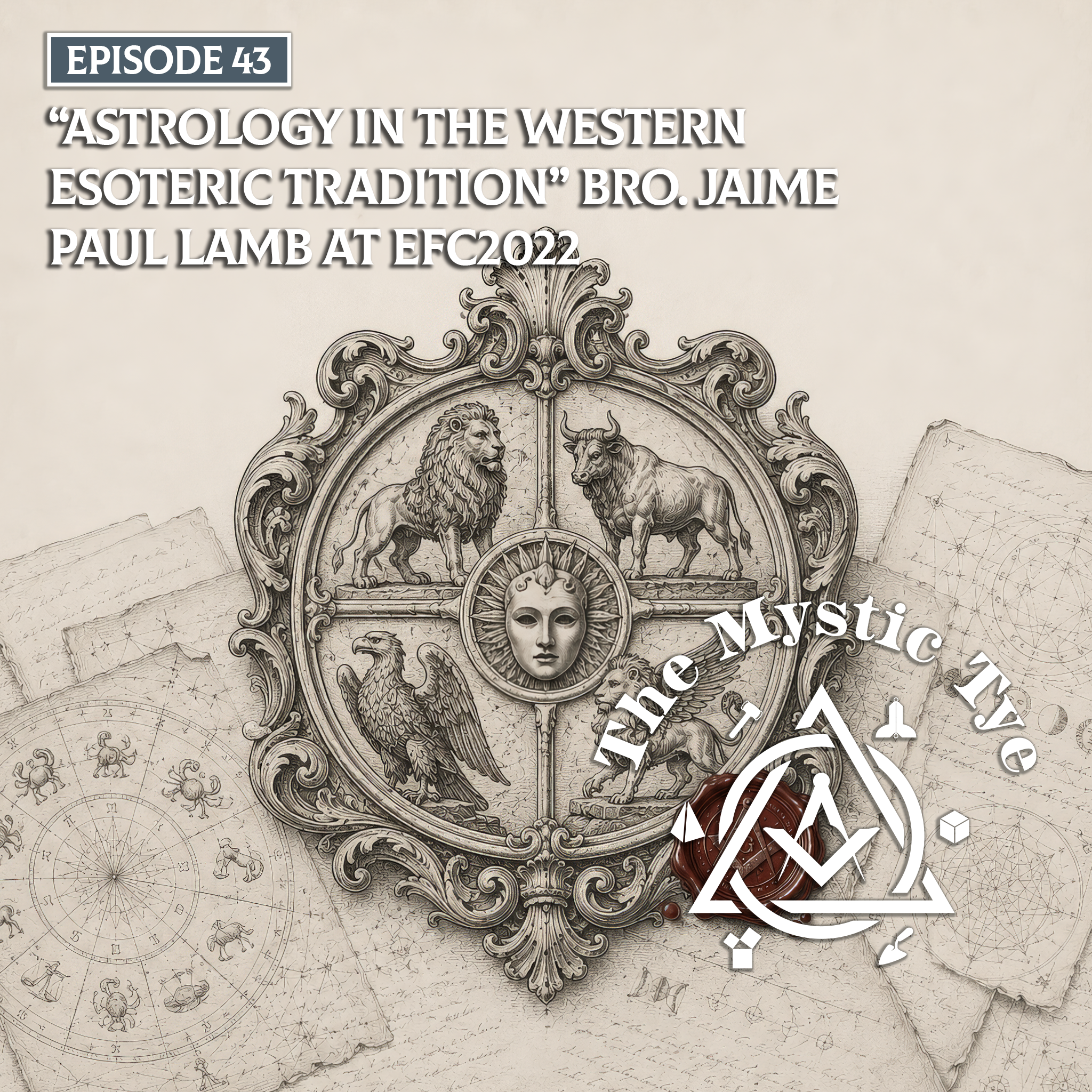
Recorded at the Esotericism in Freemasonry Conference 2022, this throwback episode features Br. Jaime Paul Lamb, professional astrologer and author. Recently uncovered from an archive of conference recordings, this presentation is titled Astrology in the Western Esoteric Traditions. Please forgive any audio irregularities, as this was captured live at the event. Slides are available to follow along on our YouTube channel.
Br. Lamb opens with a personal story: two weeks after being raised to the sublime degree of Master Mason, he came across Robert Hewitt Brown's Stellar Theology and Masonic Astronomy, a book he describes as producing a kind of Sixth Sense moment, where the symbolic architecture of the Craft suddenly resolved into something far larger. That book remains a touchstone for everything that follows.
The presentation offers a definition of astrology as the study of the mirroring of celestial events on the terrestrial sphere, the sympathetic resonant relationship between microcosm and macrocosm. Lamb draws a structural analogy: astrology is to astronomy as alchemy is to chemistry, as magic is to technology. What separates the pairs, he argues, is the quality of enchantment, the qualitative dimension that the Enlightenment stripped from the quantitative sciences and which he identifies as a genuine cultural loss.
Recorded at the Esotericism in Freemasonry Conference 2022, this throwback episode features Br. Jaime Paul Lamb, professional astrologer and author. Recently uncovered from an archive of conference recordings, this presentation is titled Astrology in the Western Esoteric Traditions. Please forgive any audio irregularities, as this was captured live at the event. Slides are available to follow along on our YouTube channel.
Br. Lamb opens with a personal story: two weeks after being raised to the sublime degree of Master Mason, he came across Robert Hewitt Brown's Stellar Theology and Masonic Astronomy, a book he describes as producing a kind of Sixth Sense moment, where the symbolic architecture of the Craft suddenly resolved into something far larger. That book remains a touchstone for everything that follows.
The presentation offers a definition of astrology as the study of the mirroring of celestial events on the terrestrial sphere, the sympathetic resonant relationship between microcosm and macrocosm. Lamb draws a structural analogy: astrology is to astronomy as alchemy is to chemistry, as magic is to technology. What separates the pairs, he argues, is the quality of enchantment, the qualitative dimension that the Enlightenment stripped from the quantitative sciences and which he identifies as a genuine cultural loss.
Lamb traces the history of astrology beginning in the Mesopotamian cultures of Sumer, Akkadia, Assyria, and Babylon, where a proto-astrology of celestial omens developed into electional astrology, astrological magic, and the first recorded articulation of the as-above-so-below axiom, found in the Babylonian diviners' manuals centuries before the Tabula Smaragdina formalized it. He follows this transmission through Homer and Porphyry's interpretation of the Cave of the Nymphs, Plato's Myth of Er, and into Hellenistic astrology proper, which he defines precisely: planets in signs in houses and how they are aspected. Those four components, he argues, are what distinguish astrology from related but distinct celestial traditions.
The cosmological model underlying all of this is Ptolemaic: the sublunary sphere of the four elements surrounded concentrically by the seven etheric planetary spheres, the sphere of the fixed stars and zodiac beyond that, and the primum mobile or unmoved mover at the outermost limit. Lamb calls mastery of this model the ring-not-pass of understanding everything else in the tradition. Without it, the rest won't hold.
He develops the Platonic-Hermetic account of the soul's descent through the planetary spheres accompanied by its daimon, taking on character qualities at each sphere, and connects this to the predictive logic of natal astrology: Heraclitus' ethos anthropos daimon, character is destiny. The natal chart, on this reading, is a schematic of that descent, a map of the character the native carries into embodied life.
Porphyry receives particular attention as Lamb's preferred Neoplatonist, distinguished from Plotinus and Iamblichus by his technicianlike insistence on understanding the mechanics of the ascent rather than simply contemplating union with the One. His commentary on the Cave of the Nymphs and his introduction to Ptolemy's Tetrabiblos are recommended as entry points.
The presentation continues through Gnosticism (which Lamb engages with reluctantly, finding its cosmology inelegant but noting the relevance of the demiurge concept for Freemasons thinking about the Grand Architect), Mithraism (its planetary grades, the Anabasis through the spheres, and the tauroctony as a star map showing Perseus atop Taurus with Scorpio, Canis Major, and Hydra below), and the Perso-Arabic transmission through Baghdad and Harran, where the Sabians preserved and developed the tradition, producing the Picatrix and forming the basis of the Solomonic grimoire tradition in Europe.
The Sefer Yetzirah is addressed as proto-Kabbalistic rather than Kabbalistic proper: its three mother letters corresponding to three of the four elements, its seven double letters explicitly planetary, and its twelve single letters explicitly zodiacal. This is not interpretation, Lamb notes. It is in the text.
Marsilio Ficino and the Renaissance reception of the Hermetic corpus receive dedicated attention. Ficino learned to play a seven-stringed modal lyre specifically to draw down planetary influences by matching musical modes to planetary spheres, an act Lamb identifies as practical Hermetic magic in the Neoplatonic sense.
The single slide devoted to Freemasonry proper covers the circumambulation of the lodge as primary motion mirroring the sun's path, the Senior Deacon as a Hermetic psychopomp archetype corresponding to Mercury, and the tetramorph, the lion, ox, eagle, and man of Royal Arch heraldry, as the four fixed signs of the zodiac traced from the Babylonian lamassus through Ezekiel's vision in captivity and into Revelation.
Lamb closes with a brief critique of Theosophical astrology, sun-sign pop astrology, and the twelve-letter alphabet system, contrasting these with the ongoing scholarly recovery of Hellenistic and Perso-Arabic techniques from critical editions of the Greek, Latin, and Arabic sources. He identifies this as a significant moment in the history of the art. The Q&A touches on the difference between Vedic (sidereal) and Hellenistic (tropical) astrology, and the foundational document of Jyotish, the Yavanajataka, which translates as Nativities of the Greeks.
Br. Jaime Paul Lamb's published works are available at the sales table. His next manuscript, which he describes as addressing Platonic cosmology before the Kabbalistic Tree of Life, is underway.
Resources mentioned:
Stellar Theology and Masonic Astronomy by Robert Hewitt Brown (available as a Kessinger reprint)
Approaching the Middle Chamber by Br. Jaime Paul Lamb
Tetrabiblos by Ptolemy, with Porphyry's introduction
The Corpus Hermeticum, especially the passage on anagogic ascent through the seven planetary spheres
Picatrix (Perso-Arabic grimoire, foundational to the Solomonic tradition)
Sefer Yetzirah (proto-Kabbalistic, letter-to-planet and letter-to-zodiac attributions)
Chris Brennan's Hellenistic Astrology course
Christian Astrology by William Lilly